

The Rotten Side of Apple
Without any surprises the report about Apple’s own chatbot came out after Meta announced Llama 2 with Microsoft as the preferred partner to launch it on Azure cloud. The partnership must have hit Apple hard. To add to the wound, Meta CEO Zuckerberg even posted a photo with Microsoft CEO Satya Nadella which is a very rare occurrence.
While Apple’s Vision Pro has garnered significant attention in the news, the company has chosen to stay mum on the topic of generative AI. During the second-quarter earnings call on May 4, CEO Tim Cook notably omitted any remarks about artificial intelligence in his prepared opening statements, setting Apple apart from other major tech vendors who frequently discuss AI advancements.
“As you know, we don’t comment on product roadmaps,” Cook commented when questioned by Credit Suisse analyst Shannon Cross about his perspective on generative AI as a whole and how the technology will integrate with Apple’s products
The Bloomberg report contradicts the notion that Apple is shying away from generative AI. As per the report, Apple is putting a lot of effort into advancing AI, and several teams are working together on this project, according to insiders who wish to remain anonymous. They are also actively working to address any privacy concerns related to the technology.
Apple is synonymous with closed ecosystems in the tech industry. Whether it’s their hardware, software, or user experience philosophy, Apple has always advocated for a walled-garden approach, ensuring tight integration between its products and services.
It is known for accessing open source tools without contributing to the development of the technology. Aleksa Gordic, ex-Google DeepMind / Microsoft ML engineer reflecting on the same said that he wished LLaMA 2 license was somehow applicable to fundamental AI research to force Apple to have to publish their internal research.
“They never give anything in return yet benefit enormously from research coming from all the other big tech companies. It just doesn’t feel right.” he added.
I wish Meta's LLaMA 2 licence was somehow applicable to fundamental AI research to force Apple to have to publish their internal research first before they can use other companies' research in their products.
— Aleksa Gordić
They never give anything in return yet benefit enormously from…(@gordic_aleksa) July 20, 2023

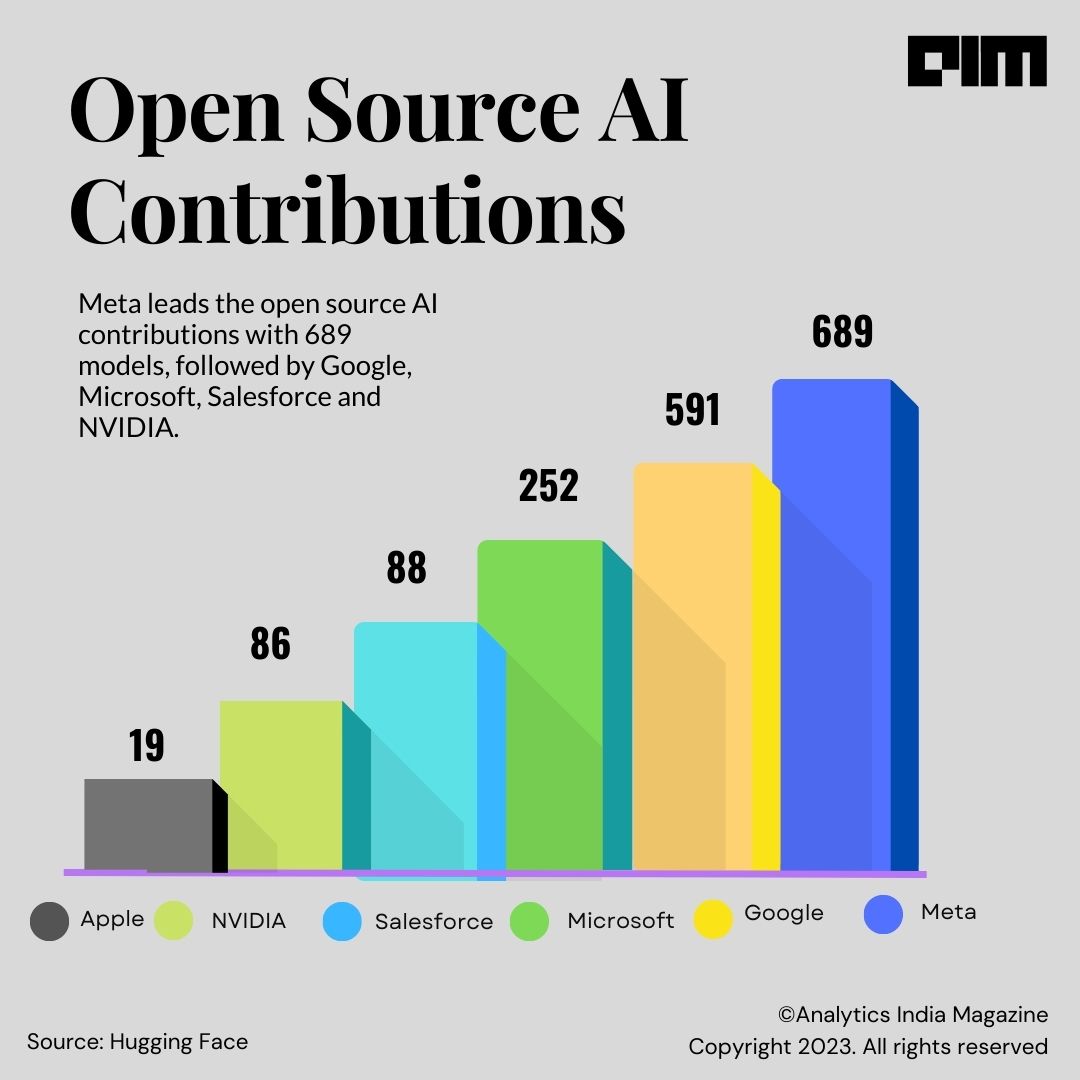
It is quite selfish of Apple to not contribute anything substantial to the open source community According to Hugging Face stats Meta holds the highest number of contributions to the open-source community, followed by Google and Microsoft.
Not Contributing to Open Source Community
The notion of Apple being secretive is not a recent one; it has been ingrained in the company’s culture since the days of Steve Jobs.
This approach, however, has its pros and cons. On one hand, it shows that Apple is dedicated to its customers, creating a private ecosystem that prioritizes confidentiality and doesn’t disclose personal excessive details. This helps Apple to gain customers’ trust with their data. Chatbots are the most lucrative way for any company to gain data. If Apple is able to gain customers’ trust with their Chatbot who knows enterprises might also adopt it as confidentiality is key for them.
However, this raises questions about whether Apple is actively contributing to the tech society. In the technology space, advancements do not occur in isolation; collaboration is essential. Meta has embraced this approach consistently. On the other hand, Microsoft, a crucial partner of OpenAI, has chosen a different route by collaborating with Meta. Microsoft is actively exploring open-source opportunities and acting as a bridge between GPT-4 and Llama 2 to position themselves for future advancements.
Interestingly, Apple’s Ajax system is built on top of Google Jax, the search giant’s machine learning framework and Apple’s system runs on Google Cloud, which the company uses to power cloud services alongside its own infrastructure and Amazon.com Inc.’s AWS.
Also,”GPT,” which stands for “generative pretrained transformer,” was originally coined and developed by Google in 2018. It serves as the foundation for both OpenAI’s ChatGPT and Apple’s GPT. If Apple has taken so much from its competition, they should also pay back to them.
Drawing comparison, OpenAI which started as an open source non-profit company turned into a closed system,capped-profit company in 2020 following the footsteps of Apple. But, now, things seem to be changing. Now even OpenAI is now looking at releasing the weights of its models. In the race of AI advancement, Apple seems to be quietly selfish. It’s time they collaborated and contributed more for the benefit of the AI ecosystem, and not just build the ecosystem around their products and services for its customers.
The post The Rotten Side of Apple appeared first on Analytics India Magazine.