

As Elections Approach, AI Reshapes Electoral Analysis in India
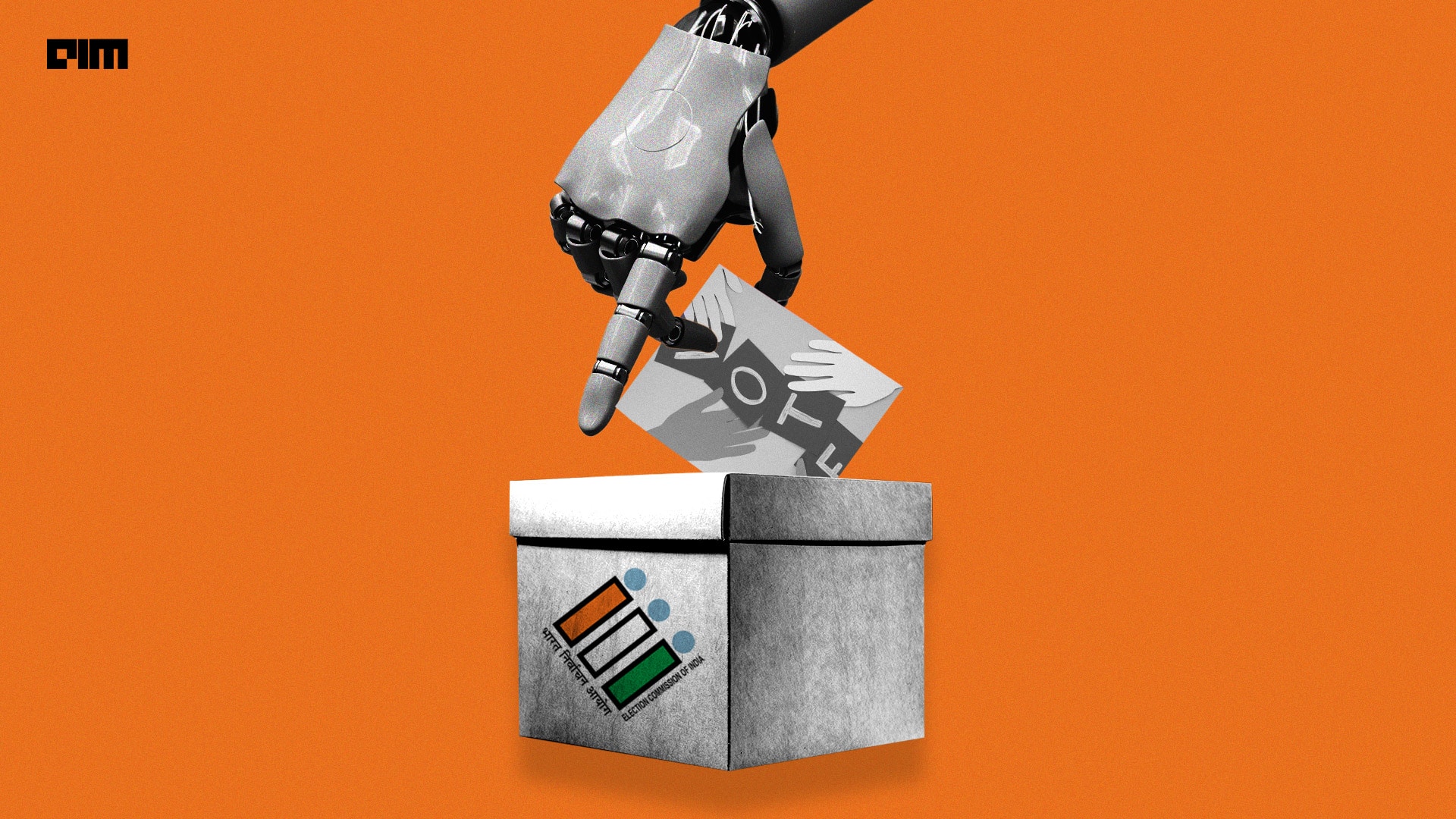
With the Bihar, Kerala, West Bengal and Tamil Nadu state elections approaching, discussions about using AI to collect and analyse election data have intensified. The innovative use of AI in the 2024 Lok Sabha elections proved to be a dominating force, although not always for the right reasons.
Machine learning algorithms were employed to understand and analyse voter turnout and election results, while natural language processing techniques were applied to analyse political speeches and content shared on social media platforms.
Despite these advancements, significant concerns over data privacy and algorithm biases remain critical issues to address in this field. While AI improves data management by collecting and analysing substantial volumes of data, it also carries the risk of distorting that information.
In a conversation with AIM, Rajeeva Laxman Karandikar, an Indian psephologist, reflected on his early involvement in election prediction nearly 25 years ago. He highlighted the effectiveness of properly chosen statistical samples, noting that even relatively smaller samples of 10,000 to 12,000 respondents can provide reliable assessments.
Rajeeva stated that his perspective has evolved over time, despite initially being sceptical about the use of different kinds of data. He acknowledged that relying solely on either pure data or easily sourced data presents limitations, with both extremes proving problematic.
Discussing the role of AI in predictive analysis of voter behaviour, political scientist Sandeep Shastri explained that a wide range of AI tools are now used to analyse voting behaviour and electoral trends, helping many to make projections and draw conclusions.
However, he argued that, ultimately, the dynamism of human behaviour—especially in terms of voting habits and political preferences—means that we need more than just AI; we also need human intelligence.
“Are we asking the right questions of AI? If we pose the wrong questions, AI will provide analyses based on those misdirected queries. We must consider whether we are using AI as a tool or becoming overly dependent on it for our analyses,” Shastri added. He believes that those who can effectively leverage AI by asking the right questions will have the opportunity to gain deeper insights that they can further analyse themselves.
When asked about AI enhancing traditional methods, Karandikar expressed uncertainty about current AI models used for elections and the data they use. He pointed out the difficulty in accurately tagging social media users to specific constituencies, limiting its direct applicability at that level.
Karandikar suggested that combining social media and reporter data, with careful consideration of reliability, could provide insights into overall trends and swing constituencies, acknowledging the increased possibilities compared to his early experiences.
When creating a wholesale product, it’s essential to conduct a customised analysis based on specific situational factors involved. “The nature of the inquiry can significantly impact the results you receive. How you frame your question will shape your answer. If you ask surface-level or overly simplistic questions, you may be misled,” Shastri emphasised.
According to Karandikar, there is a significant risk of AI-driven analytics overfitting historical biases and reinforcing social and political marginalisation, particularly in policy formulation. He noted that societal biases would not only be present in the data but could be amplified by AI models. He does not believe AI can effectively debunk misinformation in a highly polarised election scenario.
For example, in the 2024 Indian elections, AI-driven systems enabled platforms such as Meta to greenlight political advertisements that provoked violence against Muslims, worsening the dissemination of divisive and inflammatory material.
He emphasised the critical need for human supervision when using AI, particularly for issues with significant societal or policy implications.
Shastri believes that election forecasts and exit polls have a minimal impact on people’s voting decisions. According to him, individuals typically form their voting preferences well before any projections are made, whether generated by AI or determined by human analysts.
With over 30 years of experience in election analysis, Shastri explained that social media and AI do not significantly impact voter opinions. He stressed that while people use these platforms for information, they primarily engage with them for entertainment rather than to shape their opinions. “I am yet to find myself in a situation where AI has changed opinions, that is, only rainforest opinions,” he said.
However, deepfake videos featuring Tamil Nadu’s J Jayalalithaa and M Karunanidhi appeared last year, endorsing current candidates and stirring feelings of nostalgia and loyalty among voters. The Communist Party of India-Marxist (CPI-M) utilised AI to assist veteran Buddhadeb Bhattacharya in connecting with voters.
These applications raise ethical issues, as they leverage the likenesses of elderly or deceased individuals without their permission, potentially manipulating the electorate’s emotional reactions.
A study by Social Media Matters found that 80% of individuals voting for the first time encountered misinformation, with 30% of it coming through WhatsApp. In a survey conducted during the 2025 Delhi elections by The 23 Watts, 91% of participants aged under 25 felt that fake news could impact their voting decisions, while 80% acknowledged it influenced their opinions, 59% were affected by sensationalised content, and 45% shared unverified information. While the immediate effects might appear negligible, the long-term consequences could alter election results and diminish trust in institutions.
Karandikar reiterated that the primary concern with election forecasts influencing voter behaviour is not AI but the manipulation of underlying data. He argued that manipulation can occur without AI, pointing to instances of exaggerated data claims by channels.
Notably, Rajeeva advocated for minimal public disclosure standards for election-related data collection and analysis, including the period of collection and supervision details, which are often lacking.
The post As Elections Approach, AI Reshapes Electoral Analysis in India appeared first on Analytics India Magazine.

