

These Drones are Flying at 18,000 Ft, Above the Himalayas for the Indian Army

Drone technology in India has shifted rapidly from novelty to necessity. Once used primarily for surveillance and cinematography, drones are now being integrated into critical operations from high-altitude defence logistics to internal inspections at industrial facilities and large-scale agricultural spraying.
While government schemes are promoting adoption among rural communities, regulatory bodies such as the Directorate General of Civil Aviation (DGCA) have streamlined certification processes to support a growing ecosystem of drone manufacturers.
Amidst these developments, drones from Bengaluru-based manufacturer Scandron are paving the way in high-altitude logistics, becoming the first to receive DGCA type certification for logistics drones. These machines have successfully flown with heavy payloads at high altitudes, delivering critical supplies to the Indian Army troops stationed in some of the world’s most treacherous and remote terrains.
In an exclusive interview with AIM, Arjun Naik, the founder and CEO of Scandron, shared his views on this industry, the company’s presence at Aero India 2025 and offered a sneak peek into Scandron’s upcoming collaborations with the Indian Navy.
These drones have not only replaced mules and porters in Himalayan military posts but also entered sectors such as agriculture, internal industrial logistics, and infrastructure inspection.
High Above the Himalayas
“We’ve had drones fly up to 18,000 feet with 50 kilos,” Naik said. “In January, in minus 20 degrees Celsius, with 30-40 kmph winds and knee-deep snow, the drone took off, climbed above the clouds, and delivered supplies where no helicopter could go.”
Recalling one particular mission near Malari in Uttarakhand, Naik said that the drone landed in a spot that was inaccessible even to helicopters. “The jawans clapped when we landed. They said, ‘Now we’ll finally get food in this area.’” In places where porters take six hours to climb with 20 kg loads on their backs, Scandron drones complete the job in just 10 minutes.
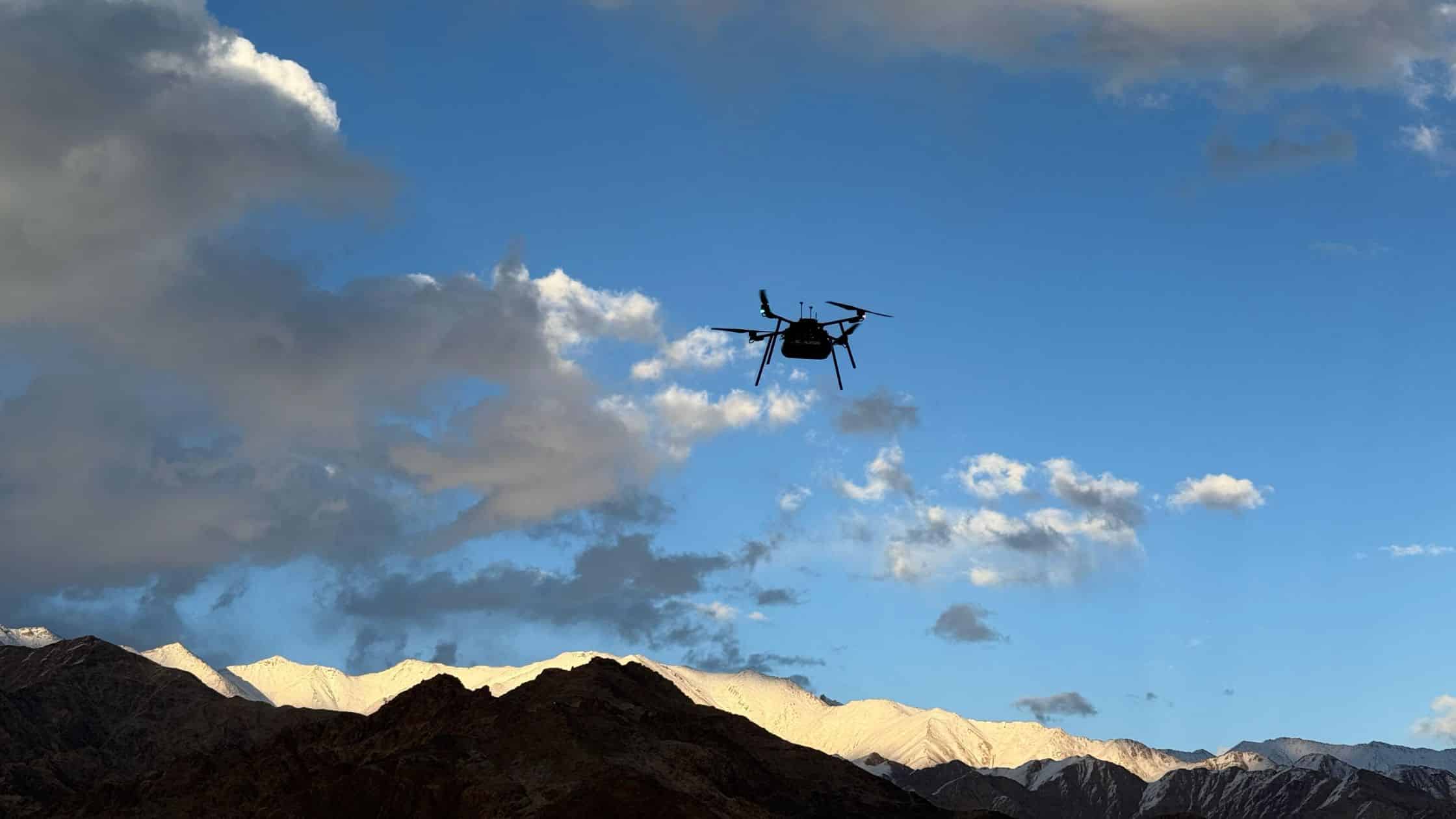
During another such major test, a drone took off near Tawang in Arunachal Pradesh, ascending through snow, clouds, and fierce headwinds to reach a military outpost across over 5,000 metres.
Moreover, the company has built a dedicated high-altitude testing and manufacturing facility in Leh. Drones are designed to operate with lower lift capacities at higher altitudes, in stronger winds, and in severe cold conditions. These adaptations include reduced payloads, excess power buffers, and structural reinforcements.
“We don’t just fly drones, we help the armed forces understand how to use them,” Naik explained. “It’s not only logistics anymore. The next question is: can we mount other equipment, maybe even armaments?”
Agriculture Meets Automation
Scandron isn’t focused on defence alone. Its drones are participating in the ‘Namo Drone Didi’ scheme, empowering women farmers in India’s rural fields to spray crops more efficiently and safely. Manual pesticide spraying is being replaced by AI-assisted, targeted spraying that maps fields and applies chemicals only where needed.
“This cuts pesticide use and exposure,” Naik added. “We’ve even partnered with fertiliser companies to find optimal spray concentrations for different crops.”
Beyond spraying, Scandron is experimenting with district-level crop intelligence using drone mapping, though Naik admits it will require more coordination and government involvement to scale.
The company also supports large solar parks by transporting solar panels within vast facilities. “We are the only company that has drones large enough to move solar panels for installation,” Naik further said.
No AI Takeover Just Yet
Despite the buzz around AI implementation, Naik is clear-eyed about what AI in drones really means.
“There is no AI ecosystem in drones. All that stuff like target acquisition and autonomous warfare, that’s 20 years away,” he says. The company implements AI in its intelligent safety algorithms.
Scandron drones are designed to decide mid-flight if they can complete a journey based on battery status and wind resistance. They also have the capability to decide if they have enough battery to reach the destination. “If a drone is four kilometres in, but has used 60% of its battery, it turns around automatically.”
Autonomy in these drones is limited to functions like pinpoint landings, obstacle avoidance, and flight adjustments. “AI today is great for safety and data analysis. That’s where the real application is,” he clarified.
The company also runs simulation-based design processes, but insists on live testing in every condition. “You can’t fight a war in a lab,” Naik said. “Eventually, you have to fly the drone in snow, sun, rain, and wind.”
Grounded in India, Open to the World
Scandron designs its drones entirely in-house and manufactures 90% of its components in India. Yet, Naik is pragmatic about India’s electronics limitations.
“India is not poised to manufacture electronics today,” he says. “We lack the infrastructure and know-how. Specialised components like thermal cores or battery cells are made by only a few global players.”
Nevertheless, government incentives, streamlined drone certification processes, and access to military testing zones are giving companies like Scandron a platform to grow. Naik has also denied the existence of regulatory delays in the industry. “It’s a structured process. People just expect everything overnight.”

Despite a strong domestic market, Scandron is not insular. “We’re open to global partnerships, provided they add value,” Naik said. The company operates a drone-as-a-service vertical for industrial clients, including Reliance and Indian Oil Corporation Limited (IOCL), performing internal inspections during shutdowns. “What took a month with cranes, we do in hours with drones,” he noted.
Long Flight Path Ahead
India is the world’s third-largest user of drones after the US and Israel, driven by active defence zones and internal security needs. However, Naik cautions against believing the hype surrounding the scale of the Indian drone industry.
“People say $10 billion market or $2 billion market. But we are a fraction of that. Drones are not mature yet. We haven’t hit mainstream adoption.”
Naik believes the next five to 10 years will bring consolidation. “It’s expensive to stay in the game. We’ve invested ₹60 crore and haven’t seen revenue yet, but that was planned.”
With a team largely comprising 23-year-olds, Scandron takes training every new hire into its own hands. “Even [graduates] from IITs [aren’t] industry-ready…The basic standard has dropped…We train everyone.”
Despite the challenges, technical or financial, Scandron continues its high-altitude climb. Whether it’s icy cliffs or solar parks, the company is betting on Indian engineering to carry weight far beyond expectations.
The post These Drones are Flying at 18,000 Ft, Above the Himalayas for the Indian Army appeared first on Analytics India Magazine.
