

Do You Still ‘Google It’?
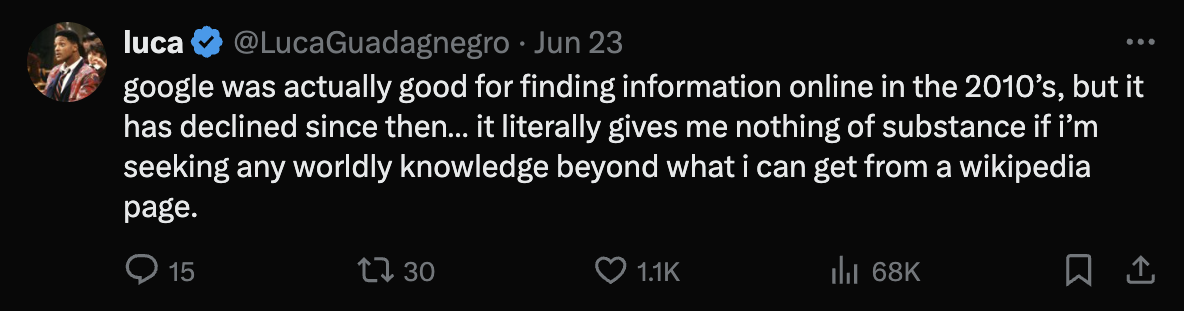
In Tom Shone’s book, The Nolan Variations, filmmaker Christopher Nolan sheds light on a thought-provoking insight: Google has far less information than one might assume.
Nolan cautions against overestimating Google’s prowess in information retrieval. “Google is not as powerful as people think in terms of information collation. They’re more powerful than people realise in all kinds of areas, such as collecting data on your movements. They’re very good at that. However, in a data search, the outcome is always limited,” he said.
“Try this experiment: visit a library, pick a random book, and jot down facts from ten random pages. Then, search for those facts online. While many think 90 percent of information is online, I suspect the real figure is closer to 0.9 percent,” Nolan suggests.
ChatGPT vs Google Search
With the introduction of OpenAI’s ChatGPT and Perplexity.AI, Google, which has long dominated as the primary source of online information, seems outdated. At first glance, comparing these to Google may seem like comparing apples to oranges, yet considering information retrieval and accuracy, the distinction blurs.
During an exclusive conversion with AIM, Zerodha CTO Kailash Nadh expressed optimism about moving away from Google Search in the future. He highlighted the challenges of finding technical solutions through traditional search methods, where users often scroll through multiple pages and countless comments to get useful information.
Nadh pointed out the efficiency of AI tools like ChatGPT and other chatbots, noting, “They’re so powerful that when you throw them a problem, they immediately suggest solutions. This saves me 45 minutes per issue—I hardly use Google for technical queries anymore.”
He believes these AI tools, by swiftly providing relevant insights, significantly streamline the search process, potentially diminishing the relevance of traditional Google searches over time.
SEO Optimised Doesn’t Mean Good Content
Not too long ago, consistently producing quality content offered a solid shot at outperforming competitors on search engine result pages (SERPs), securing rankings and attracting more organic traffic.
Today, while good content remains crucial for the website, it alone isn’t sufficient to compete.

Recently, Google introduced AI Overview in search results in the US, marking one of the most significant updates to its search engine in 25 years. These results, displayed at the top of the search page, provide users with a condensed overview before delving into the typical list of blue links.
Many experts believe generative AI in search has reduced organic search traffic by over 3%, and many businesses are facing the blunt reality of their website traffic dropping significantly since its recent algorithmic update.
A study by Search Engine Land has predicted an 18% to 64% decrease in organic clicks due to generative search.
This search is poised to influence various query types, from its influence on featured snippets and knowledge panels to its effects on search ads, navigation, transactional queries, and even long-tail queries.
It’s important to note that mobile disparities, website quality issues, accidental content alterations, and technical SEO challenges can all negatively impact traffic.
What’s Next?
Google Search dominates with 99,000 queries per second, 8.5 billion daily, and 2 trillion annually. According to Statista, as of April 2023, it attracted 83.9 billion global visits monthly.
However, its competitors are growing with Baidu at the top of the search market in China, and Yandex as the main search engine in Russia.

In the age of Gemini, Google Search is in the midst of an evolution. It now empowers users to ask multiple questions at once, leveraging the formidable capabilities of its AI model for a seamless search experience.
The era of search engines is far from over, instead, we’re witnessing a shift towards AI-driven exploration.
The post Do You Still ‘Google It’? appeared first on Analytics India Magazine.