

How GPT-4 is Better than Radiologists
There is a dearth in the radiologists in the country. Data shows that there are approximately 20,000 radiologists to serve a population of over 1.4 billion people. That is, one radiologist for every 1,00,000 individuals, a ratio significantly below the recommended benchmarks by global healthcare organisations.
This shortage coupled with physician burnout continues to plague the industry, emphasising the urgent need to deliver scalable and practical solutions to improve process efficiency amid growing demand for diagnostic imaging.
GPT-4 to the Rescue
Microsoft recently published a paper “Exploring the Boundaries of GPT-4 in Radiology” which focuses on assessing the performance of GPT-4 in text-based applications for radiology reports.
One of the primary applications of GPT-4 in radiology lies in its ability to process and comprehend medical images, ranging from X-rays to MRIs. The paper said that “Radiology report summaries created by GPT-4 are comparable and in some cases, even preferred over those written by experienced radiologists.”
Microsoft collaborated with Nuance to undergo this study and found out that GPT-4 in some tasks achieved about a 10 percent improvement over existing models. One of Nuance’s generative AI products is PowerScribe Smart Impression. This product uses natural language processing (NLP) to automatically generate draft radiology reports.
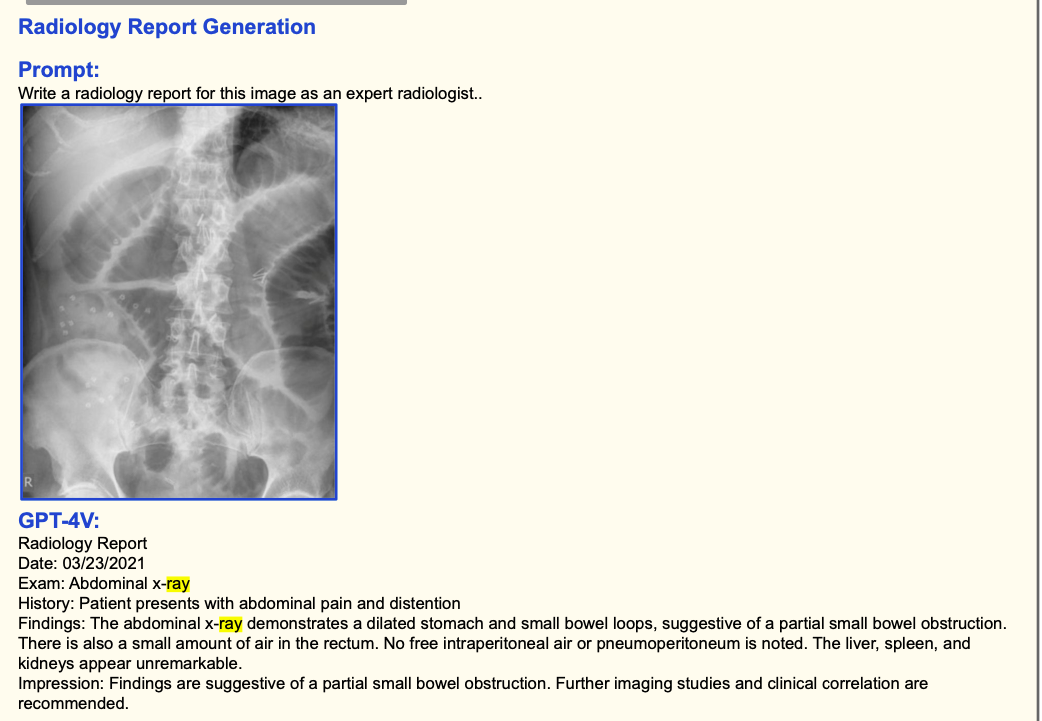
Now, with the incorporation of GPT Vision, GPT-4 is truly multimodal, boosting its capabilities and broadening its range of applications. The ChatGPT app is currently available on both Android and iOS. Radiologists need only scan the radiology reports, and GPT-4 will interpret them, offering summaries, medication suggestions, and diagnoses. Alternatively, medical professionals using the ChatGPT app can also leverage the GPT-4 Vision API.
Another encouraging prospect of GPT-4, is its ability to automatically structure radiology reports. These reports, based on radiologist’s interpretation of medical images like x-rays, including the patient’s clinical history are often complex and unstructured, making it difficult to interpret.
Moreover, research suggests that organising these reports can make it easier for healthcare professionals to understand and improve the searchability of information for research and quality improvement.
Additionally, using GPT-4 to structure and standardise radiology reports can further support efforts to augment real-world data (RWD) and its use for real-world evidence (RWE). This can complement more robust and comprehensive clinical trials and, in turn, accelerate the application of research findings into clinical practice.
Interestingly, Microsoft is not the only one experimenting with generative AI in radiology. Recently, Jama Open Network conducted a study and found that chest radiograph reports, created by a generative AI matched the quality and accuracy of reports by in-house radiologists in a retrospective study. Utilising an open-source model from Hugging Face, the study included 500 chest radiographs that the AI model decoded.
Challenges and limitations
GPT-4 can function as a valuable assistant to radiologists, but it shouldn’t be viewed as a total replacement for human judgment. Ultimately, it’s a language model trained on vast amounts of data and is not immune to errors, biases, or manipulation. Radiologists shouldn’t blindly trust or rely on GPT-4’s outputs without verifying their validity and reliability. Check the sources, references, and evidence behind its texts.
Moreover, effective prompting plays a key role when utilising GPT-4, especially in healthcare. Microsoft recently published a report stating that with proper prompting, a generalist GPT-4 model can perform comparably to a specialist on medical challenge problem benchmarks.
No doubt GPT-4 is an asset in radiology but beyond radiology, the capabilities of GPT-4 stretch into translating medical reports into more empathetic and comprehensible formats for patients and other healthcare professionals.
A user on X shared “GPT-4 is reading scans and creating radiology reports — sometimes better than experienced doctors! Imagine this being applied to blood tests and all other kinds of diagnostic tests. Medicine is going to change forever.”
The post How GPT-4 is Better than Radiologists appeared first on Analytics India Magazine.