

Oracle Doesn’t Want You to Care About Data Anymore
Oracle, the hottest cloud provider, announced several of its AI strategies at Oracle CloudWorld 2023 held in Las Vegas. One of the key focuses was the multicloud bet, where the cloud provider is integrating its services within Microsoft. Apart from that, the company is gravely concerned about how companies’ want to use data for building AI products and analytics for decision making.
Oracle’s massive portfolio of business applications with horizontal applications like ERP, HCM, supply chain CX, as well as vertical applications like health, financial services, retail, and HR, give the company a tremendous trove of data.
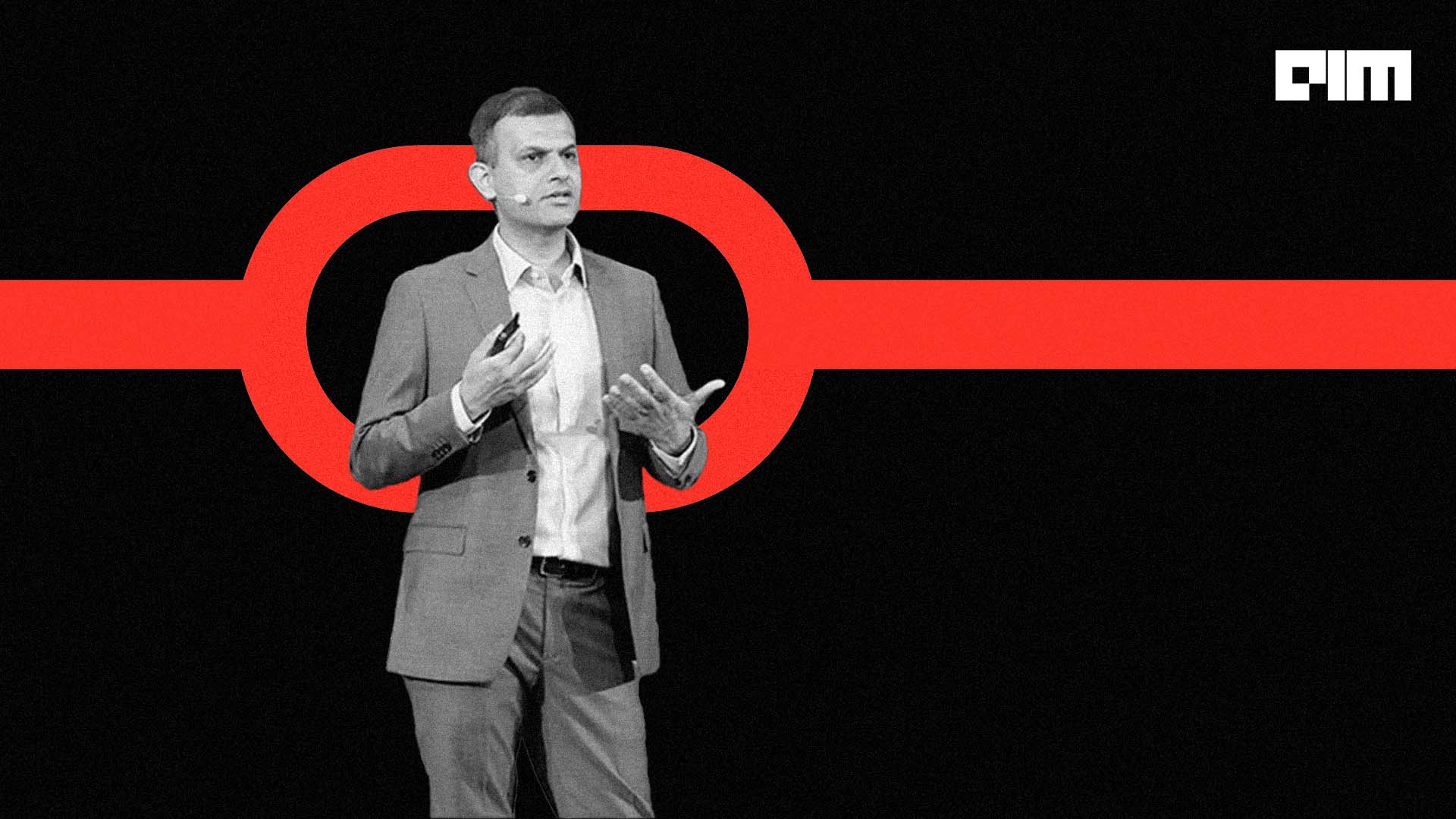
“If you just leave the AI aside for a moment, our customers struggle with data. The hardest part about doing analytics, or even AI, is getting the right data in the right place in the right shape – it’s hard work.” said T.K. Anand, Executive Vice President of Product Development at Oracle, who now heads Oracle Cloud Infrastructure (OCI) data analytics platform, when speaking to AIM at OracleCloud World 2023, Las Vegas. Before Oracle, Anand was with Microsoft for more than two decades overseeing Power BI, SQL Server BI, and Azure Analysis Services.

Anand begins by emphasising what sets Oracle apart from other cloud providers. Oracle combines both cloud platform infrastructure and cloud business applications, which it calls Fusion Analytics, creating a unique advantage. He highlights the importance of this approach in shaping their analytics strategy, mirroring this duality.
Oracle has been doing this for the last four years. Within OCI, Anand oversees the analytics segment, which he highlights is data agnostic. This means that customers can harness the power of Oracle’s analytics tools for a wide range of data sources, whether it’s stored in Oracle databases or brought in from on-premises systems.
Fusion Analytics saves the day
Oracle’s treasure trove of data is not just raw data; it’s data with contextual meaning. They understand the intricacies of various business domains, enabling them to create tailored analytics and Software as a Service (SaaS) offerings. The focus is on infusing machine learning into these solutions to drive predictive analytics, not just descriptive analytics.
“Nobody comes into work in the morning and says, ‘today, I’m going to look at data’”, Anand said when speaking about how every average business user wants its daily activities to be powered by data, not just making sense of it manually. “Data has to just disappear behind the scenes and just influence what they are doing.”
For this, Fusion Intelligent Applications is the way to go for Oracle. The cloud provider has been doing that within the healthcare industry quite successfully for some time now after the acquisition of Cerner, the company that provides health related IT and hardware services. Just like any other business problems, healthcare is also one of them. “How can we reduce the occurrence of teenage diabetes? The solutions and how you manage the problem and how you help the provider to take care of it is all powered by data,” explained Anand.

Leveraging generative AI and natural language generation (NLG), instead of just converting line graphs and bar graphs into maps and charts, OCI lets you convert the data into narrative visualisations. “We are working with Cohere to make it even better,” said Anand. “Some people call it copilots, but essentially it is an experience right within this experience where you can interact and chat with the assistant, and it will give you insights and recommendations. You can choose to ignore it, you can choose to use it, ultimately, the user has to be in front of the analyst who’s in control.”
2024 is going to be huge for Oracle
Anand touches on Oracle’s pricing strategy, stating that Fusion Analytics and the upcoming Fusion Data Intelligence Platform will follow a model consistent with Oracle’s existing offerings. While existing pricing is user-based for applications, platform services like OCI follow consumption-based pricing. Future pricing for new functionalities will be revealed closer to their general availability.
“It’s already in the market. The core ML analytics will be there in the next seven months,” said Anand. For this Oracle has not only partnered with US companies like Deloitte or PwC, but also partnered with Infosys, Wipro, TCS, who are already leveraging it in various ways. “Even before the data analysis platform is readily available in its full capabilities, it is being received well by our customers, because we understand the fusion of data and analytics unlike any other cloud provider.”
When it comes to pricing, OCI’s pricing is similar to SAS models, making it easy for customers. They pay per user or employee, no matter how heavily they use it. “It doesn’t matter if you have 100 or 10 employees.” This simplicity eliminates complexity. Like Salesforce and other SAS providers, OCI’s pricing depends on user licences. This approach makes it easy for customers to understand.
Regarding scaling, OCI aims to cater to specialised tech needs and workforce skilling. They want to achieve a high attachment rate to Fusion customers, even if some have already made other investments. OCI offers free trials and an innovation sprint program for customers to try before buying, making it accessible to more users.
Anand underscores that Oracle’s approach is to simplify pricing for customers, providing a straightforward model that’s easy to understand. In contrast to complex pricing structures that vary based on usage intensity, Oracle’s approach aligns more with traditional SaaS providers ensuring transparency and predictability.
“AI is a cool new tool, among the 20 others at the home depot”
For Anand, generative AI is kind of like a buzzword and a cool new tool. “Businesses run towards adopting it for the hype without necessarily understanding if it is going to benefit them at all. I am excited about the customer’s business problem and to know their data, so we can apply AI to real world problems.”
“When you have to hire a partner, they have to tell you how to use the tool. But with Oracle, we know that customers do and want, that we can apply it to solve a real problem,” concluded Anand.
The post Oracle Doesn’t Want You to Care About Data Anymore appeared first on Analytics India Magazine.


