Is IBM the NVIDIA of Quantum Computing?

Undoubtedly, NVIDIA has been at the forefront of AI in terms of providing hardware and even software capabilities. On the other hand, it seems like it has been relatively quiet on the other technological front—quantum computing. In this field, IBM has been taking the shots and providing everyone with the capabilities, while also giving others a run for their money.
According to the recent International Data Corporation (IDC) report IBM is the leader in MarketSpace on quantum computing systems, followed by Rigetti Computing and Quantinuum in the major players segment.
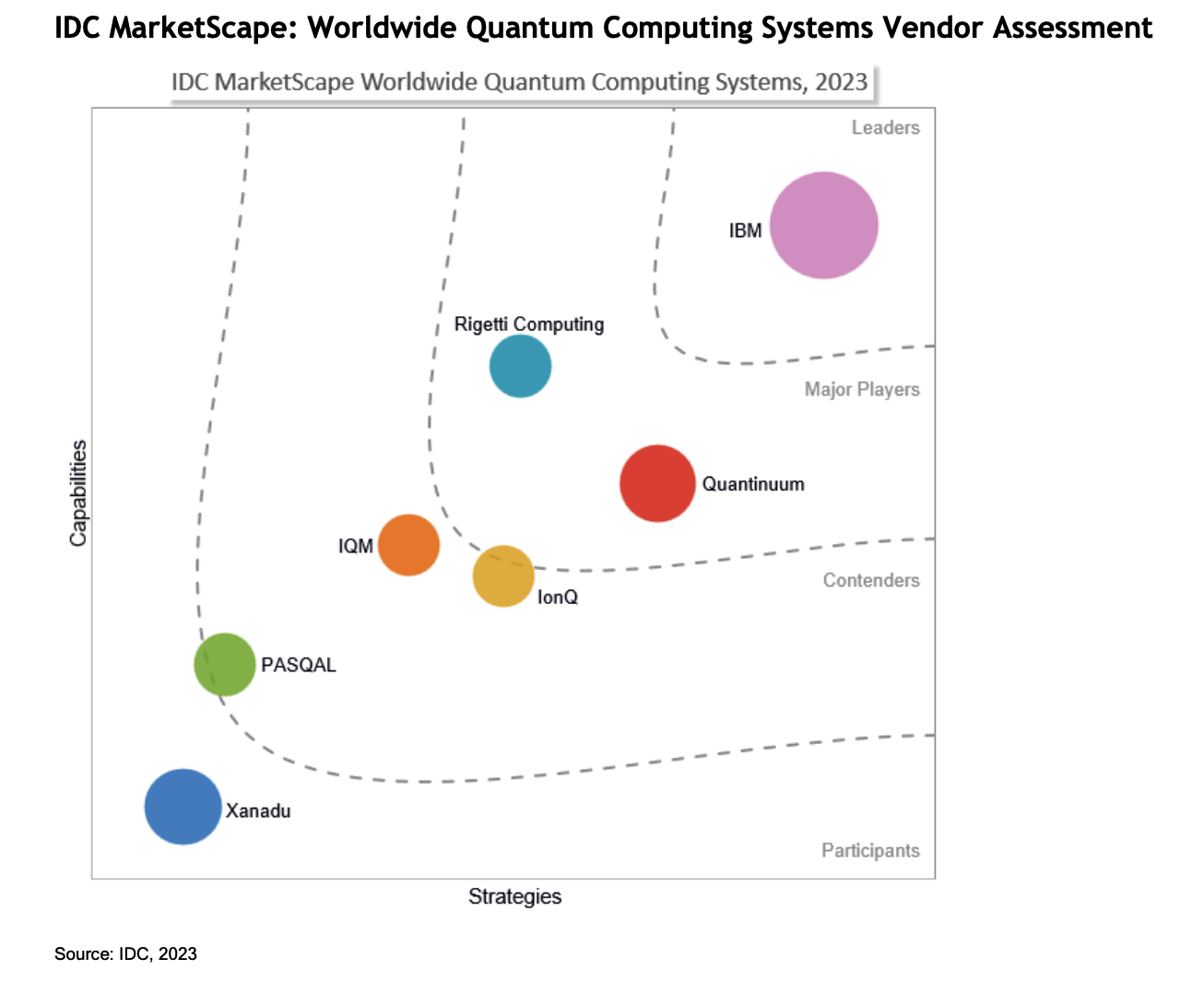
Interestingly, NVIDIA is nowhere to be found in the report.
NVIDIA chief Jensen Huang seemed to care less, and told AIM that it would take at least two more decades for quantum computing to be actually useful, or even exist. “It needs to be classical plus quantum,” said Huang. The algorithms we create today are not going to run well on quantum computers as they need to be made on quantum computers. “Classical computers will not go away,” and would be a part of the future of quantum computing.
How to be the NVIDIA of quantum
“We support every single quantum computing centre in quantum computing,” expressed Huang. NVIDIA believes that it is making big strides in quantum computing. AWS, Oracle, Deloitte, and few others have been leveraging cuQuantum on their servers. The company has been accelerating research in quantum computing through cuQuantum, its CUDA-like SDK built for accelerating quantum computing research which is using NVIDIA Tensor Core GPUs for speeding up quantum circuit simulations.
But when it comes to IBM, the company has been following a similar approach for the last five decades and has been making big claims when it comes to quantum computing. But the claims are slowly taking shape for the company. IBM says that Boeing, Samsung, Sony, Vodafone, Capgemini, JP Morgan Chase & Co, MIT are members of the IBM Quantum real applications.
In 2022, Arvind Krishna, CEO of IBM said that organisations would be able to deploy quantum computers “in the 2023 to 2025 time frame” and a 4,000 qubit system would be available by 2025. This was possibly a hint at the company’s plan to combine 3 Kookaburra processors, totaling into 4,158 qubits, according to the roadmap.
However, NVIDIA is married to the idea of classical computing, as that is what has been earning the company the most bucks at the moment. It has announced many plans and partnerships in recent months like the DGX Quantum – a system which couples GPUs, which is classical, and quantum computing.

NVIDIA’s approach is quite different from IBM’s quantum only approach.
What is IBM doing right?
NVIDIA has been in the AI game for the last 30 years, and that is how long it took for the company to be the leader. At the NTU speech Huang said that in spite of the several failures, the company’s approach made it to where it is today. It made its first GPU in 1999 and then with the release of CUDA in 2007, the company made parallel processing for AI computing possible for everyone in the world.
Similarly, IBM started its quantum computing journey in 1970 and over the last five decades, the company has continuously invested in quantum research, focusing on the research and design of a full-stack superconducting quantum computer. However, according to IBM’s review on the quantum computing report, the company’s focus is not just on being the best, but also enabling an entire ecosystem of quantum and craft a path to quantum advantage.
It is clearly visible in IBM’s approach towards quantum computing. In 2016, the company took the first step in advancing the quantum computing industry by releasing its 5-qubit system to the IBM Cloud. This was the first time a quantum computing hardware was made available for research and public experimentation, along with the software release of Qiskit, an open source and hardware-agnostic SDK for running on quantum computers.
Forging ahead, in 2017, IBM decided to release a client-facing IBM Quantum Network for providing quantum computing-as-a-service (QCaaS) for the companies, governments, academic institutions, and startups as well for full experimentation with the company’s quantum hardware.
NVIDIA’s optimistic approach towards AI, and a little pessimistic one towards quantum computing is understandable. NVIDIA is a careful trotter in quantum, and is all about discipline. Taking the example of CUDA, NVIDIA made AI accessible to all, and now its wants replicate its success in quantum computing.
“The foresight was accelerated computing. The foresight was making this architecture exactly the same for everybody. Having the discipline of staying true to that platform for generation after generation, believing that eventually our install base would be so large that not only would we have reach, but applications would therefore be enabled by us. New applications that weren’t possible before would discover us,” said Huang, in an interview with CNBC.
Now, all NVIDIA needs to do is move forward with the same approach, while IBM leads the way, breaking boundaries making powerful quantum computers – the same way it made the first computer.
The post Is IBM the NVIDIA of Quantum Computing? appeared first on Analytics India Magazine.