

ChatGPT Plus vs ChatGPT Enterprise

Four months after announcing plans to launch ChatGPT Business, OpenAI has finally released ChatGPT Enterprise. By offering top-tier security and privacy for enterprises, and serving as an AI assistant for companies, the product is considered a threat for SaaS startups that have developed products around ChatGPT or created wrappers around ChatGPT APIs to cater to business customers.
With ChatGPT Plus also offering additional features, how different are both the products? Let’s find out.
Features After Features
When ChatGPT Plus subscription was launched in February at $20/month, the subscribers were said to receive a number of benefits such as general access to ChatGPT (even during peak times), faster response time and priority access to new features and improvements. OpenAI also called out saying that it will refine and expand its offering based on feedback, and explore lower-cost plans, business plans, and data packs. While nothing on low cost plans materialised, they did launch GPT-4 the following month, whose access differentiated ChatGPT Plus users from free users.
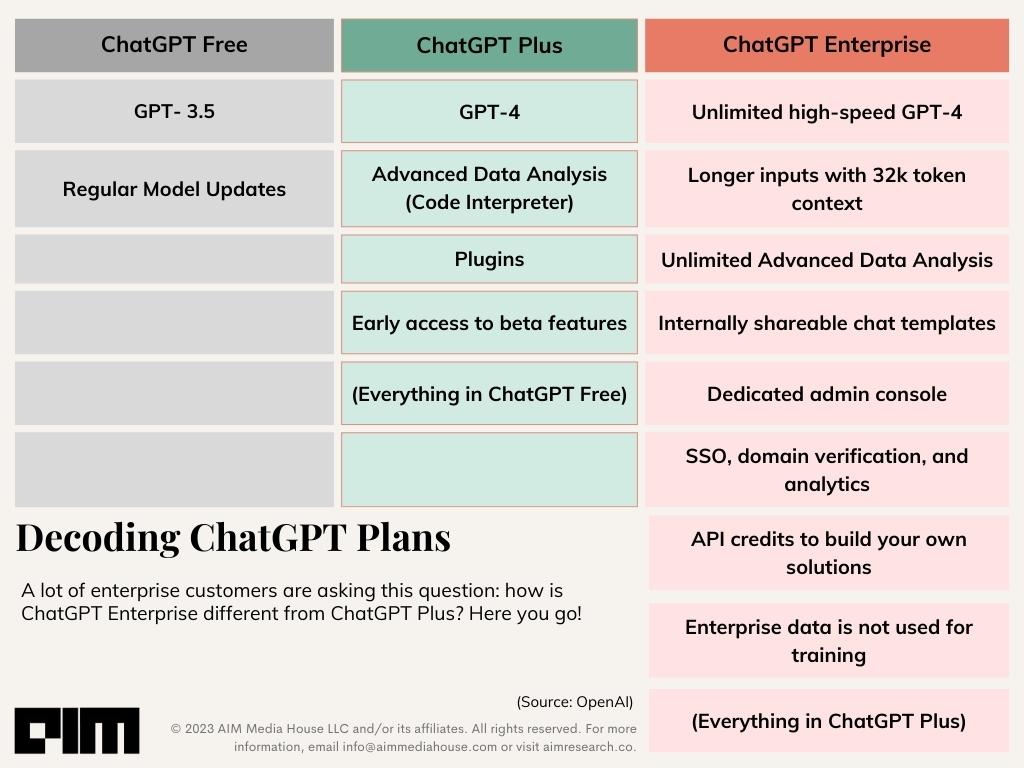
In addition to GPT-4, ChatGPT Plus users have access to Advanced Data Analysis (previously known as Code Interpreter), plugins and early access to beta features. However, the usage for them is capped at 50 messages every three hours.
ChatGPT Enterprise, termed as the ‘most powerful version of ChatGPT yet’ by the company, is said to offer everything ChatGPT Plus does along with a list of features that are catered to enterprises. The main focus is on data security and privacy, something that has always been the point of debate when it comes to OpenAI’s data training techniques.
Heightened Data Security
OpenAI has explicitly stated that customer prompts and company data will not be used for training OpenAI models. ChatGPT Enterprise is SOC 2 compliant, which implies that it has been audited and verified to meet specific criteria in terms of security and privacy practices. The data is both securely encrypted and stored with data encryption at rest (AES 256) and in transit (TLS 1.2+).
On the other hand, ChatGPT Plus users can choose to fill a form to opt out of having one’s data from being used for improving the models. There is also an option to disable ‘chat history’ which will not save chats nor be used for training their models. These options are to be manually selected by the user.
Unlimited GPT-4
Though ChatGPT Enterprise is offering unlimited high-speed GPT-4, OpenAI has put a fine print stating that the actual speed will depend on the utilisation of their systems. However, there are no usage caps on GPT-4 access. The same applies to unlimited usage access to Advanced Data Analysis.
Enterprise Centric
Catering to enterprises, there is a 32k token context window for 4x longer inputs, files or follow-ups. To allow smoother workflow and better collaboration within an organisation, shareable chat templates will be offered. Furthermore, to enhance custom solutions, free credits to use OpenAI APIs will be offered. The product will also offer a dedicated admin console and an analytics dashboard for effective management.
OpenAI also mentioned that there are other features in the pipeline and will continue to work based on feedback as well. Some of the features in the pipeline include customisation where ChatGPT’s knowledge can be enhanced via integration of company applications, solutions for specific functions such as marketers, data analysts, etc., a ChatGPT business for smaller teams, better versions of Advanced Data Analysis and browsing optimised for work.
Interestingly, last month, the browse feature was removed from the ChatGPT application owing to data leak.
ChatGPT Plus Migration?
According to Information, in March there were 1 to 2 million ChatGPT Plus users. The number would have gone up in the months that followed considering how additional features were launched and enterprises were making do with GPT 3.5 API’s with the available setup. However, it cannot be conclusively said if all these users will migrate to the new enterprise model.
While ChatGPT Enterprise offers an array of features that are highly specific for organisations, as of now, there are no details on the subscription charges for ChatGPT Enterprise. Those interested can enquire by filling OpenAI’s sales form. It is possible that small-scale companies may deter from switching based on the price model.
While both the products are hugely different in terms of functionality and target audience, the long-term goal of OpenAI seems two-pronged. One route is through appeasing the people by offering advanced ChatGPT features through ChatGPT Plus. The second route is through catering to the large population of enterprises. By dipping feet in both waters, OpenAI is probably securing itself in a fail-safe way. However, with the price point still under wraps, it is hard to know how enterprises will adopt it when compared to other existing enterprise products offered by Microsoft and Google.
The post ChatGPT Plus vs ChatGPT Enterprise appeared first on Analytics India Magazine.