

India inches towards quantum supremacy, ropes in Finland
Last month, India and Finland launched a detailed plan for setting up the Indo-Finnish Virtual Network Centre on quantum computing. Accordingly, India has identified three premier institutes viz IIT Madras, IISER Pune and C-DAC Pune, for working with Finnish counterpart institutions for the virtual network centre.
The Finland India Quantum Network (FIN-Q n) is a joint effort driven by the Department of Science and Technology on the Indian side and TEM (Ministry for Employment and Economic Affairs) on the Finnish side. The duo is actively looking to connect research institutions and corporations in the country. The key participants on each side are nominated by the respective governmental drivers (DST & TEM).
“From the Finnish side, we have Quantum corporations like IQM, Vexlum, Bluefors, QuantrolOx, along with other academic institutions. While on the Indian side, we can expect large system integrators, quantum startups, leading institutions, etc.,” shared Aasheesh Chudasama, head of Innovation Collaboration at Business Finland, Embassy of Finland.
Further, he said that the idea is to create a sandbox environment for quantum researchers that will translate to effective networking both on an inter-country level as well as intra-country level.
Chudasama leads the Innovation Collaboration portfolio at Business Finland, Embassy of Finland in India. His work includes identifying, creating, and nurturing ecosystems in the deep tech space, sustainability, and advanced telecommunications. Prior to holding the office at the Embassy of Finland, Chudasama worked for the government of Canada, facilitating inward Foreign Direct Investments from India to Quebec, Canada.
Business Finland works on behalf of the Finnish government to take local companies globally and help them grow internationally. “Together, we develop innovative business environments and ecosystems to attract companies, talent, tourism, and investments to Finland,” he added.
India-Finland partnership
India is at an early stage of advancements in quantum technology. Two years ago, the government announced that it would allocate INR 8000 cr over five years towards the national mission on quantum technologies and applications (NM-QTA), to be implemented by the department of science and technology (DST).
“For any kind of collaborative work to be successful, the most important factor is the willingness to work together. During the past year or so, we have been talking to all the major players in the quantum ecosystems of both the countries, and there is a palpable interest on both sides to tap into each other’s potential,” said Chudasama.
The Business Finland India unit envisages a common corridor for quantum experts to share their ideas and work together in achieving the quantum edge. “This vision will be translated by the creation of Finland India Quantum Network (FIN-Q n), the details of which will be made public during the ministerial signing of Finland India Joint Declaration on Quantum Technologies later in April,” shared Chudasama.
Chudasama said that FIN-Q n would be operated in two phases. ”Phase 1” is more of a virtual corridor where researchers and industry partners decide the areas of common interests, funding mechanisms, roles and responsibilities of various agencies, development of a roadmap to co-develop a quantum computer in India, etc. ”Phase 2” will be a step closer to establishing an actual centre of distinction within India, where researchers and corporations alike can co-develop IPs.
The need for collaborative IPs in quantum technology in India
“Quantum technology is both a knowledge and capital-intensive field of research,” said Chudasama.
He said most countries at the forefront of quantum technologies typically attribute their success to decades of long research in the currently eminent hardware platforms such as Ion-trapped QC, Superconducting QC, Quantum Annealers or even Photonics QC. However, because of the nature of the technology and science involved, a 100 per cent indigenous development of a quantum computer may take several years before any commercial use case can be identified or monetised.
Finland working with India in quantum technologies will help reduce India’s downtime in the last few years and will most likely give the Indian quantum revolution a JUMP-START. Also, Finland can be a good partner for Indian quantum participants because Finland thrives on technological advancement through collaboration and teamwork around the world, based on areas of common interests and benefits.
Here’s why Finland is the coolest place for quantum computing
“Finland as a nation has always been innovation-driven, and one can see it in the amount of R&D spending at both academic and corporate levels. Innovation is in Finnish DNA,” said Chudasama.
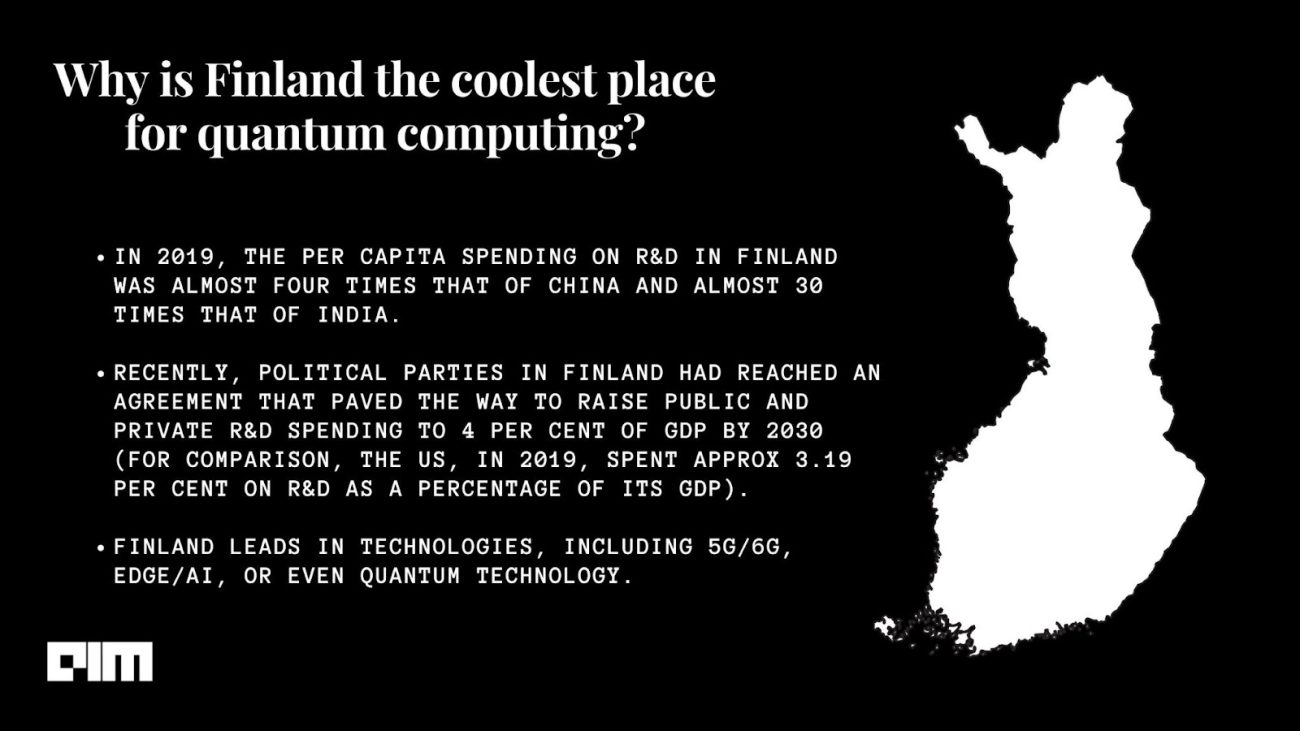
Finland vs the world
According to various reports, North America will become one of the biggest markets for quantum technologies, and China will be leading the APAC quantum technology market at $5.41 billion by 2027 with a 38.5 per cent compound annual growth rate (CAGR).
The question is, how is Finland positioned in the quantum technology ecosystem? Chudasama said that Finland could attribute its prowess in quantum computing to the multidecadal experience in low-temperature research. He added that the low-temperature laboratory at Aalto University is globally one of the leading centres in ultra-low temperature physics and technology, the key requirement in superconducting circuits and devices.
Further, he said that Finland has a very strong academic and applied research community across various educational centres throughout the country. Finland has been able to build an out-and-out quantum ecosystem focusing on various aspects of the technology.
“Finland, for example, is also home to the purpose-built research centre for micro and nanotechnology research, Ontario. Another such institution is Micronova, a joint venture between VTT Research and Helsinki’s Aalto University, which is providing research infrastructure that strengthens the quantum projects’ experimental research and the developmental capabilities of quantum technologies,” said Chudasama.
He said that Micronova’s cleanrooms are equipped to manufacture components and products based on quantum technologies. On the Optoelectronics front, the Optoelectronics Research Centre (ORC) at Tampere University probably has one of the largest groups in Europe that works in material sciences, new photonics technologies, and related applications. “This gradual build-up of expertise has led to the creation of focused startups such as Vexlum, which makes VECSELs and Pico photonics specialise in developing an ultra-compact laser for LIDAR and range finding,” said Chudasama.
In 2020, the Finnish government allocated €20.7 million (INR 1.7 billion) to develop a 5 Qubit quantum computer built jointly by VTT-TRCF (VTT – Technical Research Center of Finland) and local private companies like IQM. IQM received the largest seed funding, €11.45 million (INR 945 million).
“Finland already has a five qubit quantum computer and is currently testing the 20 qubit model. The initial phase focused on building technology and competencies linked to quantum computing, including hardware, algorithms and applications. The goal is to make a 50 qubit machine in Finland by 2024,” said Chudasama.
He said, for Finland, the long-term vision is to develop and deploy quantum technology that will transform key industrial sectors within the national economy by activating new opportunities in businesses and value-added research.
Collaboration is the only way forward
“Quantum technologies have the potential to transform human life for good. An organisation, institution, or individual will have to weigh the pros and cons of technology like quantum before making headway since we talk about long-term commitments and fairly large gestation periods,” said Chudasama.
He said large countries would have to be quantum ready not just to miss the quantum race but also to understand that the current encryption may not be secure against an attack from highly advanced quantum hardware.
“In the very near future, a nation at large will have to secure its national registries, defence communication channels, financial databases, etc., to prevent potential intrusions. On the other hand, quantum computing will also fast track drug discovery, material discovery, network optimisation, seismic imaging, etc.,” explained Chudasama, saying that it becomes imperative for all the relevant stakeholders not to miss the quantum bus; doing so may prove to be catastrophic on multiple levels.
Further, he said that startups need to explore this very wide and amazing field independently and through alliances and cooperation. “Using this race either as a marathon or a relay, I believe, will yield better results for all ecosystem participants,” concluded Chudasama.

