

Wakefit’s Puneet Tripathi on how the love for maths shaped his data science career
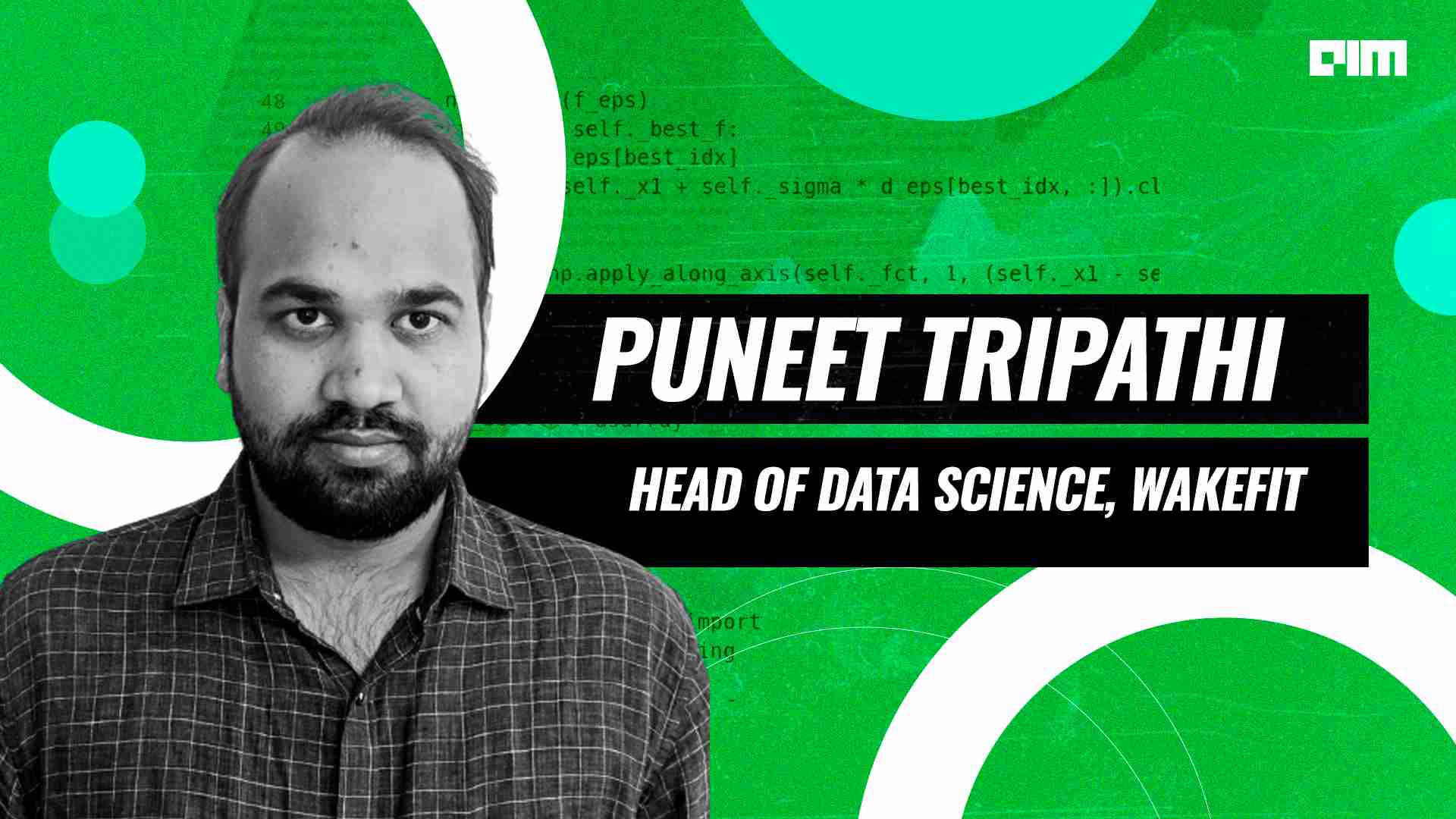
Puneet Tripathi hasn’t looked back since he graduated as a computer science engineer from the CR State College Of Engineering, Sonipat. He quickly rose through the ranks to become the head of data science at Wakefit, a modern furniture brand. He has showcased his sleight of hand in data science across domains, from working as a bio-statistician on a pharmaceutical project to building intent models for Wakefit.
In an exclusive interview with Analytics India Magazine, Puneet discussed his journey into the world of data science and his love for all things maths.
AIM: What motivated you to pursue data science?
Puneet Tripathi: After graduating in 2010, I started my career at TCS. At that time, data science was gradually gaining momentum and it all fell under the single term called Analytics. In the early years, data science and its applications were only limited to business intelligence and warehousing. Data science had a very specific use case in pharmaceuticals and banking, with credit underwriting and CIBIL scores becoming known terminologies. However, while considering multiple project-driven opportunities in TCS, my fascination with data and math guided me. Working in the lines of the scientific and mathematical aspects of engineering was my primary motivation for choosing this career choice.
AIM: When did you start preparing for a data science career?
Puneet Tripathi: Coming from a computer science background, I had topics like neural networks, AI-mathematics, matrix multiples and linear algebra as part of my curriculum. After getting into TCS in 2010, I got familiar with Python while working as a bio-statistician for one of the pharmaceutical clients. While evaluating clinical studies, I got familiar with statistical procedures, tests and tools utilised in the process. I started understanding the theoretical terms that I had used in my course. All these things were great motivators for me.
AIM: How important is it to start early in data science?
Puneet Tripathi: There is a lot of actual work happening in the data science ecosystem and projects that are actually helping people is what piques the interest of recruiters. It is imperative for aspirants to focus on the basic skills like Python, SQL, data visualisation, etc. that are involved in data science along with building a portfolio that highlights the depth of their knowledge. One of the trends that I disagree with is that one does not need mathematics to do data science. It is one of the most underrated but important factors in data science as mathematics helps you understand the result of your analysis and guides you to make the right inferences to carry the process forward. If possible, aspirants should create their profile in Kaggle to start solving problems, refer to books and experts. To boost their portfolio, one should create their profile on GitHub and maintain their own repositories, get familiar with UI/UX kind of development. For example, one can take industry charts from various sites and try to replicate them using R, Python or any other language.
AIM: Tell us about your data science journey.
Puneet Tripathi: After being placed in TCS, I got a deeper understanding of the SAS (statistical analysis system) while working on a pharmaceutical project. I learnt how statistical tools can be used to make inferences and analyse the copious amounts of data on drugs before they are launched in the market. After TCS, I moved to a company called Dunnhumby, a pioneer in customer science, where I worked for five years. In this time period, I worked on big data projects and was one of the few people working on Hadoop at that time. After this, I collaborated with Hindol Basu and Bijoy Khandelwal to build Actify data labs. We did some amazing work in the retail industry. My experience in retail, e-commerce and customer science is what brought me to the role of head of data science at Wakefit.
AIM: What are the major challenges/opportunities you have come across in your career so far?
Puneet Tripathi: Of the many challenges to choose from, one that stands out was the fraud identification model that I was helping build for a stock exchange firm. Not a lot of literature was available and the traditional methods took 2-3 days to calculate. We created our own mechanism to identify and predict fraud circular trades using our own rate of volatility, share movement volatility, etc. to create a trust score against malicious trade. It was a moderately powerful logistic regression model with 72% ROC. Another challenge was the amount of data to be processed. The data cache went up to 100GB and handling it in real-time was very difficult. We used the snapshot method to identify chains and predict by the end of the day if a stock will convert to a circular trade or not.
Recently, we created an intent model within Wakefit itself, to identify customers and their intent to purchase a product. With the amount of data made available by the users and the data accumulated by Wakefit, we were able to create features on the intent model that depicted the customer’s interaction with our website with probability rates of conversation.
AIM: Tell us about your plans/goals to push the envelope at Wakefit.
Puneet Tripathi: Since my induction in 2020, I and the team have been able to build a layer of intelligence in terms of dashboards, multiple data marts, NPS and multiple models. Our ultimate goal would be to help businesses with entire setups or frameworks for their progress. Businesses don’t care if you show them data, but they care for the relationship that they can build on. Building an entire platform for analysis and predictions and converting those into ideas for actionable development is what I strive for. Data has the power to become a stand-alone business entity or partner that can boost any enterprise to its full potential.
AIM: What’s your advice for data science aspirants?
Puneet Tripathi: Build your skillset, put some effort into understanding the mathematical side of data and don’t be afraid to seek guidance. People are much more receptive than we think and one can gain insights and mentorship from industry experts if you reach out to them on LinkedIn, Twitter or other sites. Understand every aspect of how things work. The essence of data is in its variation and representation.