

James Webb Telescope: NASA Launches $9 Billion Infrared Telescope
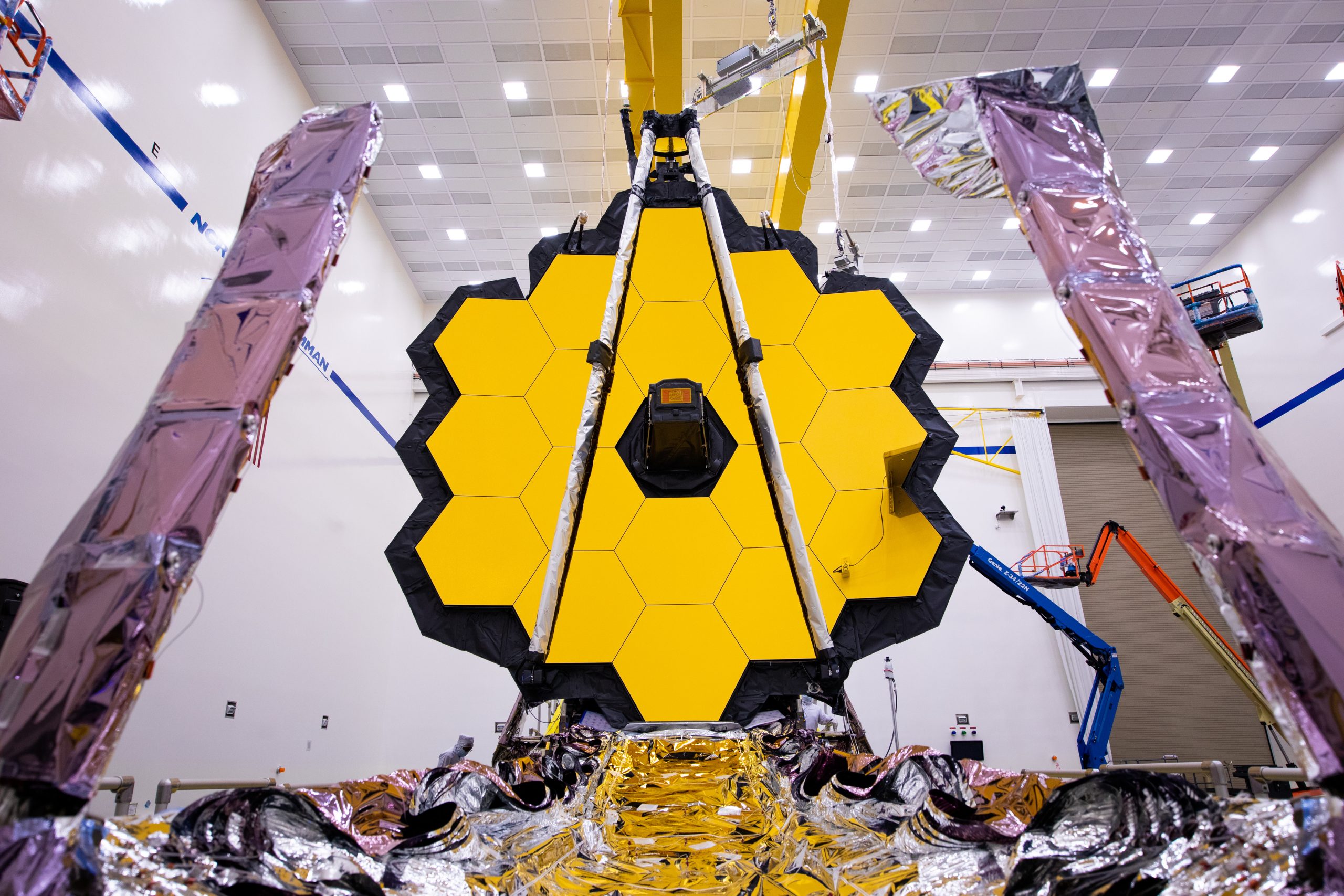
The revolutionary $9-billion infrared telescope, hailed by NASA as the premier space-science observatory of the next decade, was carried aloft inside the cargo bay of an Ariane5 rocket that blasted off at about 7.20 a.m. EST (5.50 p.m. IST) from the European Space Agency’s (ESA) launch base in French Guiana.
After a 27-minute ride into space, the 14,000-pound instrument was released from the upper stage of the French-built rocket. The instrument should gradually unfurl to nearly the size of a tennis court over the next 13 days as it sails onward its own.
The Webb telescope will reach its destination in the solar orbit about 1.6 million km from Earth — about four times farther away than the moon. Webb’s special orbital path will keep it in constant alignment with the Earth as the planet and telescope circle the Sun in tandem.
Webb is about 100 times more sensitive than Hubble and is expected to transform scientists’ understanding of the universe and our place in it. It will mainly view the cosmos in the infrared spectrum, allowing it to gaze through clouds of gas and dust where stars are born. At the same time, Hubble has operated primarily at optical and ultraviolet wavelengths.

Cosmological history lesson
The new telescope’s primary mirror—consisting of 18 hexagonal segments of gold-coated beryllium metal—also has a much bigger light-collecting area, enabling it to observe objects at greater distances, thus farther back into time than Hubble or any other telescope.
Astronomers say that in the new telescope, one can view a glimpse of the cosmos never previously seen — dating to just 100 million years after the Big Bang, the theoretical flashpoint that set in motion the expansion of the observable universe an estimated 13.8 billion years ago.
Webb’s instruments also make it ideal for searching for evidence of potentially life-supporting atmospheres around scores of newly documented exoplanets — celestial bodies orbiting distant stars — and to observe worlds much closer to home, such as Mars and Saturn’s icy moon Titan.
The telescope is an international collaboration led by NASA with the European and Canadian space agencies. Northrop Grumman Corp was the primary contractor, and the Arianespace launch vehicle is part of the European contribution.
Webb was developed at the cost of $8.8 billion, with operational expenses projected to bring its total price tag to about $9.66 billion, far higher than planned when NASA was previously aiming for a 2011 launch.
Astronomical operation of the telescope, to be managed from the Space Telescope Science Institute in Baltimore, is expected to begin in the summer of 2022, following about six months of alignment and calibration of Webb’s mirrors and instruments.
NASA expects to release the initial batch of images captured by Webb by then; Webb is designed to last up to 10 years.

