

Microsoft’s AI Advantage Puts Pressure on Salesforce, Zoho to Innovate
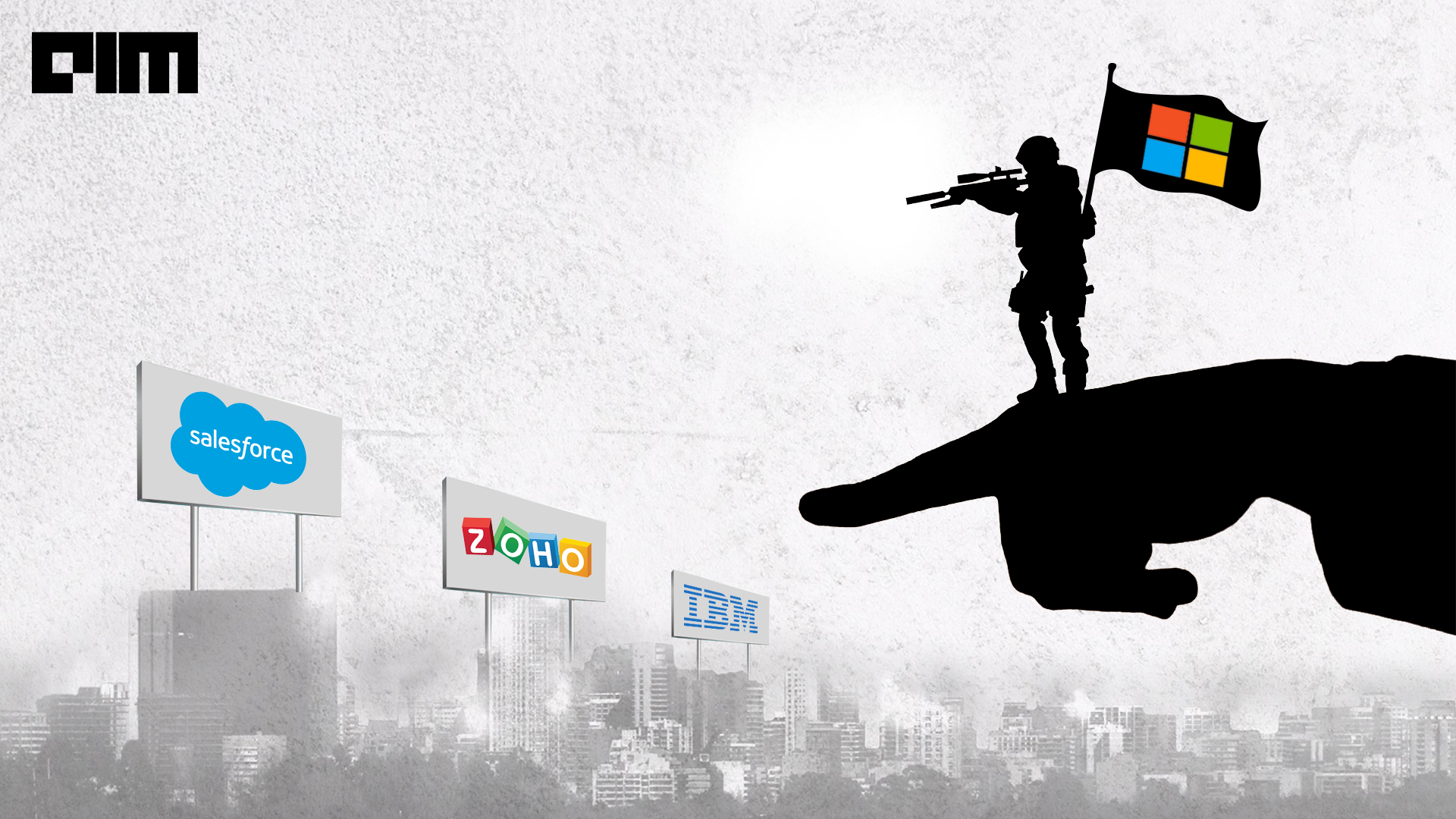
Seems like the heyday of legacy enterprise software platforms like Zoho, Salesforce, IBM, and others are soon to be over. Microsoft recently launched its Dynamic 365 Copilot, an AI-powered assistance for both customer relationship management (CRM) and enterprise resource planning (ERP) functions.
Dynamic 365 Copilot has a suite of AI tools designed for a range of business functions, including sales, service, marketing, operations, and supply chain. This way, it burst into the scene with much fanfare and posed a legitimate threat for others in the industry.
Granted some of the legacy corporations are still figuring out how to handle the safety and moral concerns of this tech before they dive in, there is something that already gives Microsoft an edge: Its partnership with OpenAI.
Salesforce hitting back
This is not the first time that Microsoft has expressed its interest in providing CRM in the cloud, which companies use to help manage their self efforts. About eight years ago, the company made a $55B bid to acquire Salesforce. Unfortunately, the talks fell through. What could have been a setback then, might be an opportunity now for Microsoft to catapult itself into this segment with generativeAI capabilities.
Alongside Microsoft, there is also SambaNova Systems that will be launching its enterprise suite which will be accessible through APIs and integrate with existing business processes.
Not to say that others are a lost cause. It will be interesting to see how companies like Salesforce and others compete with Microsoft on the AI pair programming front.
Only last month, Salesforce announced EinsteinGPT, a ChatGPT-like chatbot with abilities to “generate leads and close deals”. EinsteinGPT blends both Salesforce’s and OpenAI’s technology, enabling it to generate emails that sales personnel can send to customers, craft responses to received emails, and create “targeted content” for marketers.
The California-based company also announced the launch of a new $250 million generative AI fund to focus on responsible generativeAI. The fund will be invested in companies like Anthropic, Cohere, Hearth.AI, and You.com.
“I don’t think that Microsoft is positioned to take back huge market share from Salesforce in the CRM space. The announcement of Einstein GPT, and the deal with OpenAI, will give generativeAI proponents something to hold on to if they are Salesforce customers,” Vernon Keenan, Senior Industry Analyst at SalesforceDevops.net, told AIM.
However, it is still unknown if this would be a premature launch to show an advantage against Microsoft or did Salesforce really crack something here. “The problem is that none of the Salesforce products demonstrated today are shipping. We shall see how it goes, since there is now huge pressure for Salesforce to deliver because Microsoft has shipping versions of Copilot in the market today,” Kennan added.
What about the rest?
Salesforce has made its move. Now, it’s time for Zoho, IBM, Freshworks, and the rest of the lot to reveal their cards. There are little-to-no reports on how these companies are dealing with the GenerativeAI challenge. They have been fairly secretive about their intentions—as well as “extra cautious”, if one may put it like that.
Zoho, for instance, is known for taking an increasingly privacy-first approach. Zoho’s Ramprakash Ramamoorthy had previously told AIM, “At Zoho, we strongly believe privacy is more than just a feature and ensure a privacy-first approach in whatever we do—from building our own data centres to a homegrown AI stack”.
Likewise, when AIM tried to reach out to IBM to understand what they are doing to combat the impending challenge from Microsoft, they declined to comment.
Nevertheless, enterprise SaaS with their own AI-GPTs will soon be a reality.
OpenSource ? equal access for all
Meanwhile, there is another caveat to where the industry is going at the moment. With ChatGPT API available for everyone to access, companies have the chance to leverage upon the “democratisation” of AI, while also using Microsoft Azure to train and deploy their AI models. For example, several reports suggest that EinsteinGPT might also be powered by OpenAI’s API. Wait, is Microsoft building its own competitors?
Although it may seem like it, this may as well be another form of gatekeeping. Having complete access to OpenAI to continuously improve and build on its model, Microsoft has the power to limit what its competitors can access. Thereby, strictly building a monopoly on the enterprise software division.
In addition, the same “democratisation” also means that legacy enterprises will now face competition from a bunch of up-and-coming startups who will utilise the ‘integrate API and ship’ model of product development. Known as ‘FastSaaS’, the new model leverages the power of generative AI and low/no code to significantly lower the barrier to build software products.
We initially saw that with OpenAI’s GPT API, which caused quite a stir in the tech world. It’s already been integrated into a bunch of amazing writing and productivity tools, but now the ChatGPT API is causing an even bigger furore.
The post Microsoft’s AI Advantage Puts Pressure on Salesforce, Zoho to Innovate appeared first on Analytics India Magazine.
